
 By
By Introduction
Finding a digital marketing tool sounds simple until every comparison page names a different “best” option. One review praises fast results, while another warns about account risk.
Increditools can shorten that early research stage by collecting reviews, comparisons, feature summaries, and service categories in one place. However, a directory should help you build a shortlist—not make the final decision for you.
This guide explains its coverage, trust signals, warning signs, and a safer way to test tools before paying.
What Is Increditools and What Does It Cover?
Increditools is an online technology resource that publishes reviews and comparisons of third-party software and digital services. Its strongest visible focus is on social media growth, marketing tools, privacy-related services, proxies, and other products used by creators, marketers, and online businesses.
It is not the software developer behind most products it discusses. Instead, it acts as a discovery and comparison layer between readers and outside providers.
That distinction matters. A directory may summarize features and pricing, but the vendor still controls billing, data handling, support, delivery, cancellations, and refunds.
| Area readers may research | What to verify before choosing |
| Social media growth services | Platform-rule compliance, account access, follower quality, cancellation terms |
| Marketing and analytics tools | Data sources, reporting accuracy, integrations, export options |
| Proxies and privacy tools | Logging policy, ownership, jurisdiction, security testing |
| Automation software | Permission model, rate limits, API use, human oversight |
| General tech services | Current pricing, support quality, refund policy, recent user feedback |
The platform is most useful during the discovery stage. A freelancer might use it to compare Instagram scheduling tools, while an agency might scan several proxy providers before requesting trials.
A small business may also discover overlooked criteria such as team permissions, exports, or renewal pricing.
What the Platform Does Well
The main benefit is speed. Readers can compare basic purposes, pricing models, supported networks, dashboards, and target users without opening dozens of vendor pages.
The limit is context. A tool that suits one creator may fail for an agency managing several brands, approval workflows, and client accounts.
Is Increditools Reliable Enough for Buying Decisions?
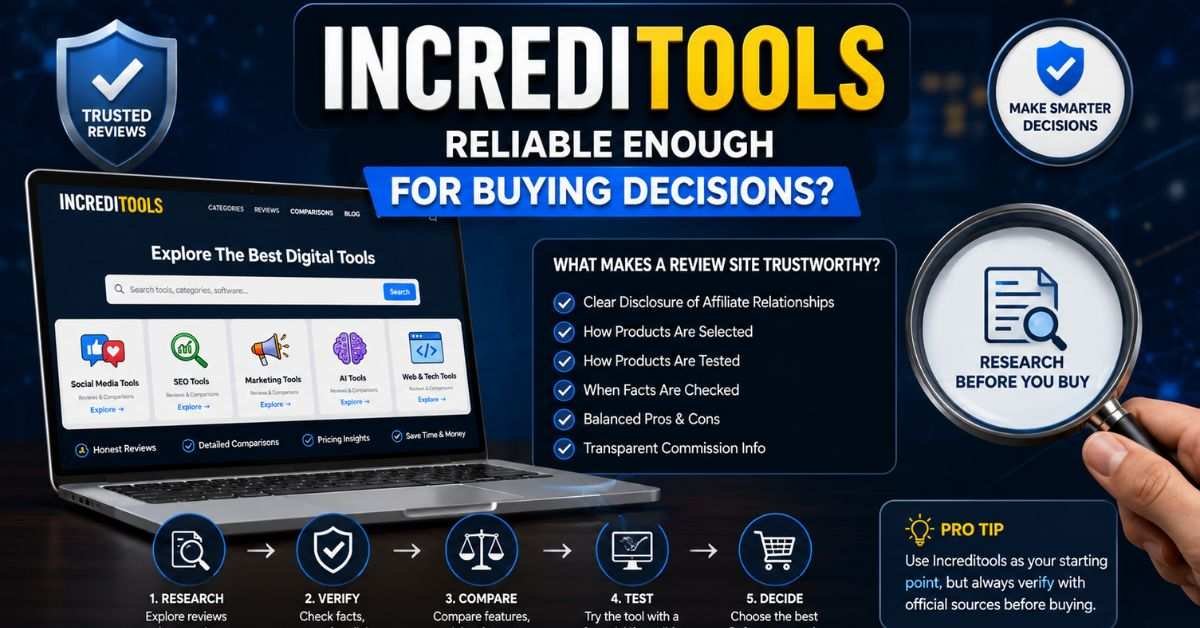
Increditools can be useful as a starting source, but no affiliate-supported review site should be treated as the only authority. A recommendation becomes more trustworthy when the page explains how products were selected, how they were tested, when facts were checked, and whether the publisher may earn a commission.
Affiliate income does not automatically make a review false. It creates a possible conflict that readers should understand.
The U.S. Federal Trade Commission says material relationships behind endorsements should be disclosed clearly and where people can easily notice them. Its consumer-review rule also addresses fake or misleading reviews, including certain AI-generated reviews.
Look for disclosure near the recommendation—not only on a distant policy page. Also check whether sponsored placements are visually separated from editorial rankings.
Use an Evidence Ladder
Not all statements deserve equal weight. Judge claims in this order:
- Official documentation: Prices, terms, privacy rules, and refunds.
- Repeatable test evidence: Dates, settings, screenshots, and measured results.
- Independent user patterns: Repeated feedback across reputable sources.
- Editorial opinion: Helpful context, but weaker without proof.
- Marketing language: Treat “guaranteed” or “instant” claims cautiously.
A good review should keep the facts separate from the judgment. Yes, it is true that “the plan includes five workspaces.” This is the greatest choice for any agency is an opinion that needs a lot more backing.
Check Social-Platform Risk Before Using Growth Tools
Some products reviewed in this market may automate follows, messages, likes, views, or connections. Official rules matter more than a review site’s safety label.
Instagram’s terms restrict automated access or information collection without permission. LinkedIn prohibits unauthorized bots and automated methods that create activity or inauthentic engagement. YouTube also prohibits artificial inflation of views, likes, comments, and subscribers.
A tool can work technically and still create policy, privacy, or reputation risk. Avoid sharing a primary password; prefer secure, documented authorization.
How to Use Increditools Without Making an Expensive Mistake
Use Increditools to create a shortlist, then verify each vendor’s current pricing, policies, security, and real-world performance. Test the lowest-risk option with limited access, measure results against a defined goal, and keep a clear exit plan.
Step 1: Define the Result You Actually Need
Do not begin with “What is the best tool?” Begin with a measurable problem.
For example, a creator may need to schedule three channels from one calendar. An agency may need client approvals and role-based access. An ecommerce team may need campaign attribution rather than more followers.
Step 2: Build a Two- or Three-Option Shortlist
Use the directory to identify two or three candidates that match your platform, budget, team size, and essential features.
Record the review date and listed price because updates, ownership changes, and new plans can make pages outdated.
Step 3: Verify Every Decision-Critical Claim
Open the vendor’s official pages and confirm:
- Current monthly and annual prices
- Automatic renewal and cancellation rules
- Refund or trial conditions
- Required account permissions
- Data storage and deletion terms
- Supported platforms and integrations
- Human support channels
For privacy or security tools, seek independent audits, technical documentation, and a clear company identity. A comparison table is not a security assessment.
Step 4: Run a Controlled Trial
Test with a secondary project, limited permissions, and a small data set. Do not connect every client account on day one.
Choose three success measures, such as hours saved, qualified leads, reporting accuracy, or cost per completed task.
| Trial checkpoint | Question to answer |
| Setup | Can a normal user configure it without hidden technical work? |
| Performance | Does it deliver the promised function consistently? |
| Quality | Are the results useful, accurate, and relevant? |
| Safety | Does it require risky permissions or prohibited behavior? |
| Support | Can you reach a real person when something breaks? |
| Value | Is the result worth the full renewal price? |
Step 5: Compare Total Cost, Not Headline Price
A low fee can become expensive after extra users, usage credits, storage, support, training, or migration. Compare the full operating cost, not only the advertised plan.
Step 6: Make an Exit Plan Before Subscribing
Export sample data during the trial. Confirm how cancellation works and whether the service deletes stored information.
For social tools, know how to remove access, rotate credentials, and stop activity. A safer tool is easy to leave.
Common Mistakes When Reading Tool Reviews
The first mistake is choosing the top-ranked product without understanding the method. Position may reflect editorial judgment, commercial relationships, limited testing, or criteria that do not match your needs.
The second is trusting precise numbers without a source. Percentages, success rates, and scores need a defined sample, date, and method.
Other common errors include:
- Treating purchased engagement as genuine audience growth
- Ignoring platform terms because a provider says its method is “safe”
- Comparing introductory prices instead of renewal costs
- Reading only positive reviews
- Giving a new service full account access
- Assuming an old review reflects the current product
Do not confuse an editorial review with verified customer feedback. Editorial opinions, vendor testimonials, and customer reviews are different evidence types and should not be blended without explanation.
Pro Tips and Best Practices
Create a simple scorecard before reading rankings. Give each candidate a score for required features, safety, transparency, support, price, and ease of exit.
Use a “must have, useful, unnecessary” system. This prevents an impressive feature list from distracting you from the one function you actually need.
Cross-check the comparison, official vendor documents, and recent independent feedback. When sources disagree, investigate why.
Keep screenshots of the offer, refund promise, and plan limits in case the page changes.
For business use, involve the daily operator. That person will notice workflow friction, missing exports, weak mobile support, or slow service.
Finally, review the subscription after 30 and 90 days. Cancel tools that create activity without improving a meaningful business result.
FAQs
Is Increditools a software company?
No. It mainly functions as a review and comparison resource for third-party tools rather than developing the listed products itself. Outside vendors control payments, support, privacy practices, delivery, and refunds, so verify the seller’s identity before purchasing.
Is Increditools safe to use?
Browsing Increditools for research is different from using a service it reviews. The safety of a listed product depends on that vendor’s security, permissions, policies, and business practices. Check official terms, independent evidence, and account-access requirements before connecting sensitive data or profiles.
Does a review lose credibility if it has an affiliate link?
No, an affiliate link does not automatically make a review unreliable. It does create a financial relationship that should be clearly disclosed. Trust improves when the publisher explains its testing method, includes disadvantages, names alternatives, dates updates, and separates sponsored placement from editorial judgment.
Can social media growth tools lead to account restrictions?
Yes, some growth or automation tools can create account risk when they use unauthorized bots, artificial engagement, scraping, or prohibited access methods. Review the relevant network’s current rules before connecting a service. A provider’s “safe” label does not override Instagram, LinkedIn, YouTube, or other platform policies.
How can I tell whether a tool review is outdated?
Check the publication or update date, then compare prices, features, ownership, and policies with the vendor’s official pages. Broken screenshots, discontinued plans, missing new features, and old platform names are warning signs. Time-sensitive facts should be verified again on the day you buy.
During a free trial, what should I test?
Test the exact workflow you plan to use, not every feature. Measure setup time, output quality, reliability, permissions, reporting accuracy, support response, and export options. Use limited data and document the results so you can compare tools fairly before the trial renews.
Conclusion
Increditools can reduce research time by organizing digital marketing tools, growth services, privacy products, and software comparisons into readable guides. Its best role is helping readers discover options and identify questions—not replacing official documentation, policy checks, security review, or hands-on testing.
Use the platform with a clear goal, a short shortlist, and a controlled trial. When you verify commercial relationships, current prices, account permissions, platform rules, and exit terms, Increditools becomes a more useful part of a careful buying process rather than a shortcut to an uncertain purchase.