
 By
By Introduction
Have you ever written “truely sorry” or “I truely believe this” and wondered if it was correct? You’re not alone. Thousands of people search for “truely or truly” every month because the spelling feels confusing.
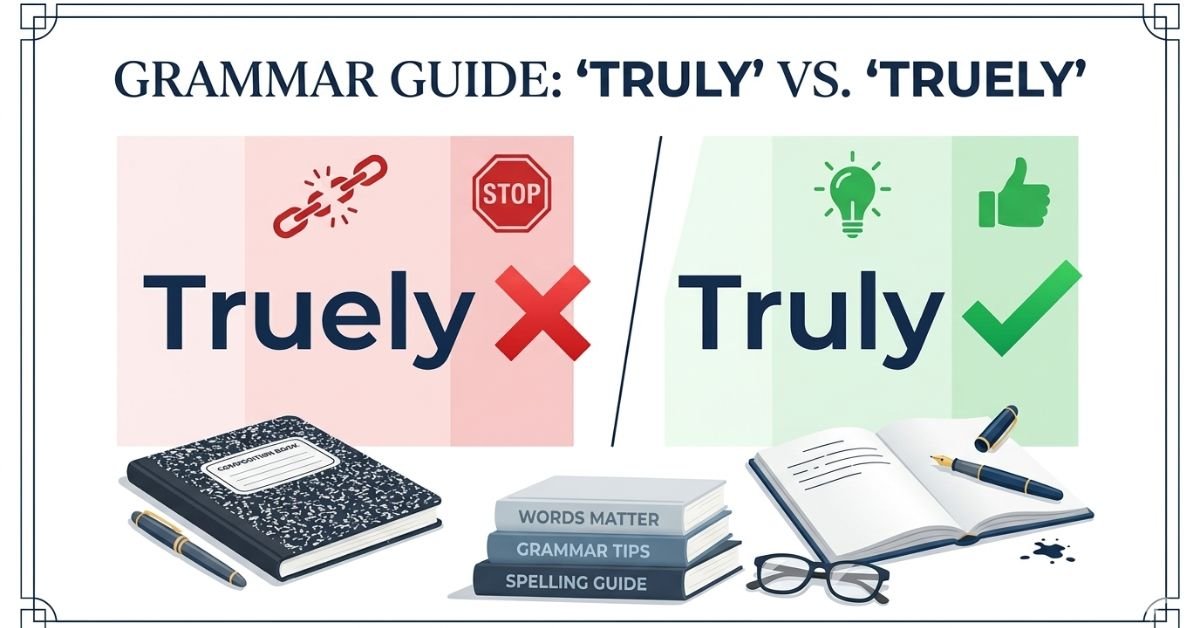
The short answer is simple: “Truly” is correct. “Truely” is a common spelling mistake.
But the reason behind it is more intriguing than you might think. In English, adverbs are usually formed by adding -ly to an adjective, yet true → truly breaks what many learners expect.
This guide explains why “truely” is wrong, why “truly” is correct, how the spelling rule works, and how to avoid the mistake permanently. You’ll also see real examples, grammar rules, and practical tips used by professional editors.
Truly or Truely: The Correct Spelling
In standard English, when comparing “truely” and “truly,” only “truly” is regarded as correct.
| Word | Correct or Incorrect | Explanation |
| Truly | ✅ Correct | Standard adverb form of true |
| Truely | ❌ Incorrect | Common spelling mistake |
Example sentences
- I am truly grateful for your help.
- She truly believes in the project.
- The movie was truly inspiring.
Writing “truely” in professional writing, emails, essays, or blog posts can make the text appear unedited or incorrect.
According to major dictionaries such as Oxford and Merriam-Webster, the only acceptable spelling of the word is “truly.”
Why “Truely” Is Incorrect
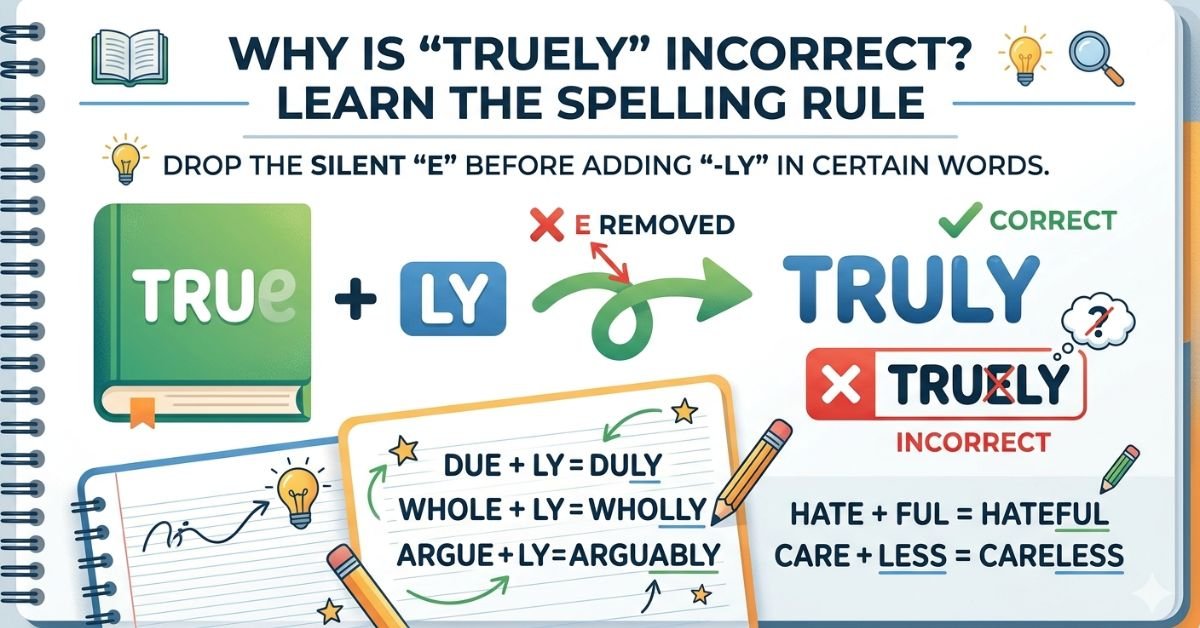
The confusion between truely or truly comes from how English typically forms adverbs.
Normally we follow this pattern:
Adjective + “ly” = Adverb
Examples:
- quick → quickly
- slow → slowly
- honest → honestly
However, when using “true,” the spelling changes slightly.
Instead of true + ly → truely, the “e” is removed.
true → truly
This happens because English spelling rules sometimes drop the final silent “e” before adding “ly.”
The Grammar Rule Behind “Truly”
English follows a specific pattern when forming adverbs from adjectives ending in -e.
Rule:
If an adjective ends in a silent “e,” the “e” is often removed before adding “ly.”
| Adjective | Correct Adverb | Incorrect Form |
| True | Truly | Truely |
| Due | Duly | Duely |
| Whole | Wholly | Wholely |
This rule explains why truly is correct and truely is absent from standard dictionaries.
What Does “Truly” Mean?
The word “truly” is an adverb that modifies verbs, adjectives, or entire sentences.
It generally means:
- In a truthful way
- Genuinely
- Sincerely
- Actually
Examples in real sentences
- I truly appreciate your support.
- She was truly surprised by the result.
- This is truly the best decision for the company.
In professional writing, “truly” often adds sincerity or emphasis.
Real-Life Usage of “Truly”
Understanding truely or truly becomes easier when you see how the word appears in real communication.
Email Example
Incorrect:
I am truely thankful for your assistance.
Correct:
I am truly thankful for your assistance.
Business Writing
Correct usage:
- We are truly committed to customer satisfaction.
- This innovation is truly revolutionary.
Academic Writing
Researchers often use “truly” when emphasizing findings.
Example:
The results demonstrate a genuinely significant improvement in performance.
Why So Many People Write “Truely”
The truely or truly confusion exists for three main reasons.
English Spelling Expectations
Most words simply add “-ly,” so writers naturally assume:
true + ly = truely
Pronunciation
The spoken sound doesn’t clearly reveal the missing e, which leads to guessing the spelling.
Typing Habits
Autocorrect tools often fix the mistake automatically, so people don’t realize they spelled it wrong.
A 2023 analysis by Google Trends and grammar-check tools showed that “truely” remains one of the most frequent spelling mistakes involving adverbs ending in “-ly.”
Common Mistakes When Using “Truly”
Even experienced writers sometimes misuse the word when dealing with truely or truly.
Mistake 1: Writing “Truely”
I am truely sorry.
I am truly sorry.
Mistake 2: Overusing “Truly”
Too much emphasis can weaken writing.
Example:
This result is truly amazing, truly fantastic, and truly perfect.
Better:
This is an amazing and fantastic result.
Mistake 3: Using It in Formal Closings
Some people write:
Yours Truly,
While correct in letters, it sounds outdated in modern emails.
Pro Tips to Remember the Correct Spelling
If you often confuse truely or truly, these memory tricks help.
Tip 1: Remember the Pattern
Many -e adjectives drop the “e.”
Examples:
- true → truly
- due → duly
Tip 2: Think “True + ly Without E.”
Just mentally remove the e before adding ly.
Tip 3: Use Grammar Tools
Professional editors rely on tools like
- Grammarly
- Hemingway Editor
- Microsoft Editor
These tools automatically correct “truely or truly.”
Truly vs Similar Words
Sometimes, writers compare the word “truly” with other words that convey emphasis.
Truly vs. Very
- Very = intensity
- Truly = sincerity or authenticity
Example:
- She is very talented.
- She is truly talented.
Truly vs. Really
- Really = informal emphasis
- Truly = stronger sincerity
Example:
- I really appreciate it.
- I truly appreciate it.
When Should You Use “Truly”?
Use “truly” when you want to express genuine feeling, confirmation, or emphasis.
Common contexts include:
- Apologies
- Gratitude
- Strong agreement
- Professional communication
Examples:
- I am truly grateful for the opportunity.
- This discovery is truly groundbreaking.
- Your support truly means everything to me.
Understanding truely or truly helps ensure your writing remains clear and professional.
FAQs
Is “truely” ever correct?
No. Truely is always incorrect. The only correct spelling is truly.
Why does “true” lose the “e” in “truly”?
English spelling rules often remove a silent “e” before adding -ly.
Example:
true → truly
Is “truly” an adverb?
Yes. “Truly” is an adverb that modifies verbs, adjectives, or entire sentences.
Example:
She truly understands the problem.
What method do you use to remember the spelling of the word “truly”?
A simple trick:
True – e + ly = Truly
Is “truly yours” still used?
Yes, but mainly in formal letters rather than emails.
Is “truly” formal or informal?
It is suitable for both contexts, but it sounds slightly more formal than the word “really.”
Why do spell checkers flag “truely”?
Dictionaries recognize “truly” as the correct spelling.
Final Thoughts
The debate around truely or truly is actually straightforward once you understand the rule.
- Truly is the correct spelling.
- Truely is a common mistake.
- The final “e” in “true” is dropped before adding “ly.”
Mastering small grammar details like this improves professional writing, academic work, and everyday communication.
Whenever you’re unsure, remember:
If something is genuine, it’s spelled “truly,” never “truely.”
Visit the rest of the site for more interesting and useful articles.