
 By
By Introduction
Efficiency and safety are non-negotiable in the dynamic construction and maintenance industries of today. Having the proper access equipment can significantly increase speed and security whether working on-site, fixing a ceiling fixture, or maintaining a high-rise building. Presenting the scissor lift, a multipurpose and safety-improving tool that has proven essential to contemporary building maintenance and construction.
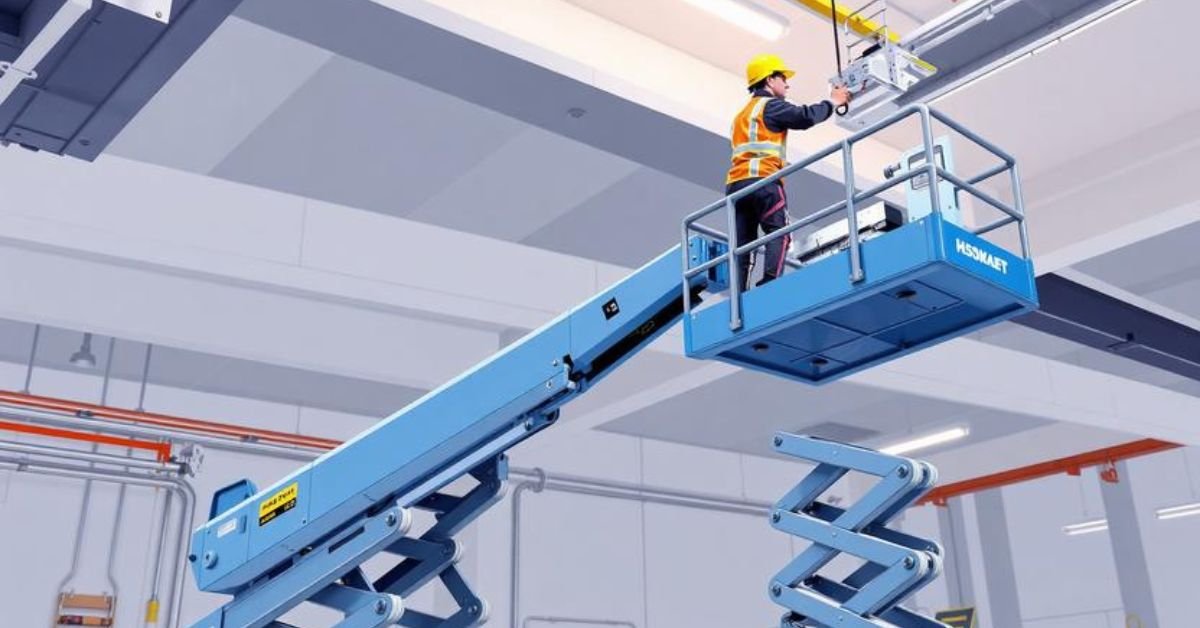
One kind of mobile elevating work platform (MEWP) used to raise personnel and supplies vertically to different heights is the scissor lift. It is well known for offering steady elevation in confined or busy areas thanks to its compact base and crisscrossing support structure. Reaching higher isn’t the only goal of these robots; they also aim to do it safely, effectively, and intelligently.
In-depth information about scissor lifts, their principal uses in construction and maintenance, their various varieties, safety precautions, and cost considerations are all included in this comprehensive book. Whether you’re a facility maintenance expert, project manager, or contractor, this article will help you make wise choices about how to use scissor lifts.
What Is a Scissor Lift? Definition and Core Function
A Scissor lift is a vertical aerial platform that raises the work platform straight above the base using a folding, connected support system formed like the letter “X” (or scissors).
Core Components:
- Platform: The area used for work where tools and people are positioned.
- Scissor Mechanism: The vertically extending arms that are operated by electricity or hydraulics.
- Base Frame: Contains the stability support system and motor.
- Control panel: Enables the operator to safely maneuver and raise/lower the platform.
Key Benefits:
- Designed exclusively for vertical lifting, it is much more stable than boom lifts.
- Typically furnished with toe boards and safety guardrails.
- Perfect for indoor work, confined areas, and situations where lateral reach is not required.
This straightforward yet reliable system significantly lowers the danger of falls and downtime by offering a safe working environment at height without the need for ladders or scaffolding.
Types of Scissor Lifts and Their Applications
Scissor lifts are available in a variety of sizes, power sources, and features to meet the demands of various projects.
| Type | Best For | Power Source | Terrain |
| Electric | Indoor use, clean environments | Electric/Battery | Flat surfaces |
| Diesel | Outdoor use, rugged terrain | Diesel | Uneven, rough |
| Rough Terrain | Construction sites and outdoors | Diesel or Dual | All terrains |
| Pneumatic | Eco-sensitive environments | Compressed Air | Indoor/Outdoor |
| Hydraulic | General use, heavy lifting | Hydraulic Fluid | All terrains |
Highlights:
- Quiet and emission-free, electric scissor lifts are perfect for inside projects.
- Large platform capacities and strong traction on uneven terrain are features of rough terrain lifts.
- Pneumatic models are appropriate for green buildings and air-quality-regulated areas.
Without sacrificing safety, having the proper scissor lift guarantees project efficiency, lowers risks, and aids in meeting deadlines.
Key Applications in Construction Projects
The use of scissor lifts is extremely beneficial for both new building and remodeling operations. They are frequently utilized by drywall specialists, HVAC installers, electricians, and general constructors.
Scissor Lift Uses in Construction:
- Electrical installations or ceiling frameworks with high ceilings.
- HVAC components and ductwork overhead.
- Installing and upgrading lighting fixtures.
- Upper wall plastering or drywalling.
- Height-appropriate metal stud assembly or framing.
Benefits for Construction Teams:
- Fast setup and breakdown, which results in daily time savings.
- Safer than temporary scaffolding or ladders.
- Able to manage larger loads of persons, supplies, and gear.
Scissor lifts reduce human labor and simplify access to challenging vertical places, enabling contractors to work more quickly, safely, and intelligently.
Scissor Lifts in Building Maintenance Operations
Scissor lifts are now essential for continuous building operations and property management duties, especially in commercial and industrial settings, in addition to construction.
Common Maintenance Tasks:
- Replacing high-bay ceiling light fixtures or bulbs.
- Cleaning the ducts and replacing the HVAC filter.
- Painting the interior or fixing the facade.
- Sprinkler maintenance and fire alarm inspection.
Why It’s Ideal for Maintenance:
- Compact variants are compatible with elevators and typical doors.
- Provides secure substitutes for lift towers and ladders.
- Lessens the need for bulky scaffolding, which takes a long time to put together.
Having scissor lifts on-site or on call ensures smooth facility management when activities or tenants rely on efficiency and safety.
Safety Tips for Operating a Scissor Lift
Scissor lifts are thought to be safer than many other elevation techniques, but misuse or inadequate training can still result in accidents.
OSHA-Compliant Safety Checklist:
- Pre-operational examination of the guardrails, controls, and hydraulics.
- Unless it’s a rough terrain model, use it only on level, firm surfaces.
- Never go over the maximum load capacity.
- Always wear a harness if your safety protocol calls for it.
- Do not use it in strong winds or close to power lines.
- Observe the manufacturer’s instructions for platform movement and elevation height.
Stats to Know:
About 25% of lift mishaps, according to OSHA, are caused by platforms that are not properly positioned or by unapproved maintenance.
The likelihood of accidents, equipment malfunctions, and project delays is greatly decreased by heeding these recommendations.
Cost Comparison: Renting vs. Buying a Scissor Lift
Is a scissor lift better to buy or rent? That is dependent on your storage capacity, spending limit, and frequency of use.
| Option | Pros | Cons |
| Renting | Low upfront cost, recent models | Long-term costs add up |
| Buying | Cost-effective for daily use | Expensive initial investment |
| Leasing | Midway solution, upgrade options | Contract obligations |
Price Ranges (Approximate):
- Purchase Price: $10,000 – $50,000+.
- Daily Rental: $100 – $150.
- Monthly Rental: $800 – $3,000.
Rentals are flexible for infrequent or short-term projects. Owning one, however, might save thousands of dollars a year for businesses that use lifts frequently.
How to Choose the Right Scissor Lift for Your Job
Four important factors must be taken into account when selecting the best scissor lift among the many available options:
Decision Factors:
- Height Requirements: Take into account the job sites’ maximum platform height.
- Load capacity: Add labor, equipment, and supplies.
- Indoor vs. Outdoor Use: Select diesel for outdoor use and electric for indoor use.
- Surface Terrain: Is the terrain uneven? Take a difficult terrain scissor lift instead.
Questions to Ask:
- Will you use this every day or just sometimes?
- Is there a problem with noise on-site?
- Is there room for me to keep it between jobs?
Operations are safer, quicker, and more economical when the appropriate model is used.
Real-World Case Studies: Scissor Lifts in Action
Case Study 1: Commercial High-Rise Maintenance
- Company: Apex Facility Services.
- Need: Replace all of the lighting fixtures in a 40-foot warehouse.
- Solution: Electric scissor lift rental (max height of 40 feet).
- Result: Two days were spent instead of five. More output with fewer ladders.
Case Study 2: Residential Building Construction
- Company: Skyline Builders.
- Need: Installing drywall in a three-story atrium.
- Solution: utilized a diesel scissor lift for tough terrain.
- Result: 80% less time was spent setting up the scaffolding, and on-site safety ratings increased.
These illustrations demonstrate how scissor lifts improve real-world projects in terms of labor, time, and safety.
Maintenance and Storage Tips to Extend Lifespan
Appropriate maintenance and storage practices are essential to guarantee durability and lower repair costs.
Maintenance Tips:
- Regularly check the batteries and hydraulics.
- Lubricate the movable joints after 100 hours of use.
- Maintain inflated and undamaged tires.
- Replace any malfunctioning limit switches and controls right away.
- Observe the OEM’s recommended preventive maintenance program.
Storage Guidelines:
- Keep out of direct sunlight and in a dry, safe place.
- Before a long-term shutdown, disconnect the batteries.
- In open spaces, cover with a protective tarp.
- In humid areas, use rust-proofing or anti-corrosion sprays.
A lift’s lifespan can be extended by up to ten or more years with proper care and routine servicing.
Innovations and the Future of Scissor Lifts
The field of aerial lifts is changing quickly due to advancements in sustainability and smart technologies.
Innovations to Watch:
- Lithium-ion battery-powered electric lift types that are environmentally beneficial.
- Platforms that level themselves on uneven surfaces.
- Integration of telematics for usage monitoring and remote diagnosis.
- Improved safety features that can be disengaged when tilted or overloaded.
Future Trends:
- Lift operation that is semi-autonomous and connected with BIM software.
- Fleet management with AI to schedule maintenance.
- Greener elevators for carbon-neutral building projects.
In the era of smart construction, these developments are expected to make scissor lifts more intelligent, secure, and cost-effective.
FAQs
What is a scissor lift’s maximum height?
The majority of scissor lifts have a range of 20 to 60 feet, while some versions go higher.
Is certification required for operators?
Indeed. OSHA mandates certification and training for aerial lift operators in order to ensure workplace safety.
Is it possible to utilize scissor lifts on a slope?
Standard models need level ground; only rough terrain models can safely traverse uneven terrain.
Do scissor lifts have a watertight design?
They’re not made for a lot of rain. Hydraulic systems and electronics may be impacted by water exposure.
How much weight is supported by a scissor lift?
Depending on the model, load capacities vary from 500 to 2,500 pounds or more.
Conclusion
Scissor lifts are essential for increasing efficiency, safety, and production in the building and facility management industries. They provide a dependable answer to vertical access problems that ladders and scaffolds are unable to handle since they are portable, versatile, and simple to use.
Whether you’re handling daily warehouse requirements, planning an inside repair project, or working on multi-level construction, knowing how to select and use the best scissor lift may provide substantial value, reduce hazards, and save money over time.
Are you prepared to equip your team with more intelligent elevation tools? Investigate local rental or buy choices to literally boost your operations.
Visit the rest of the site for more interesting and useful articles.